

This expedition is specifically designed to be experienced in portrait mode.
Reload the session if something feels stuck.
Play the intro sequence again.
Display a real-time framerate indicator.
Permanently delete all exploration data.
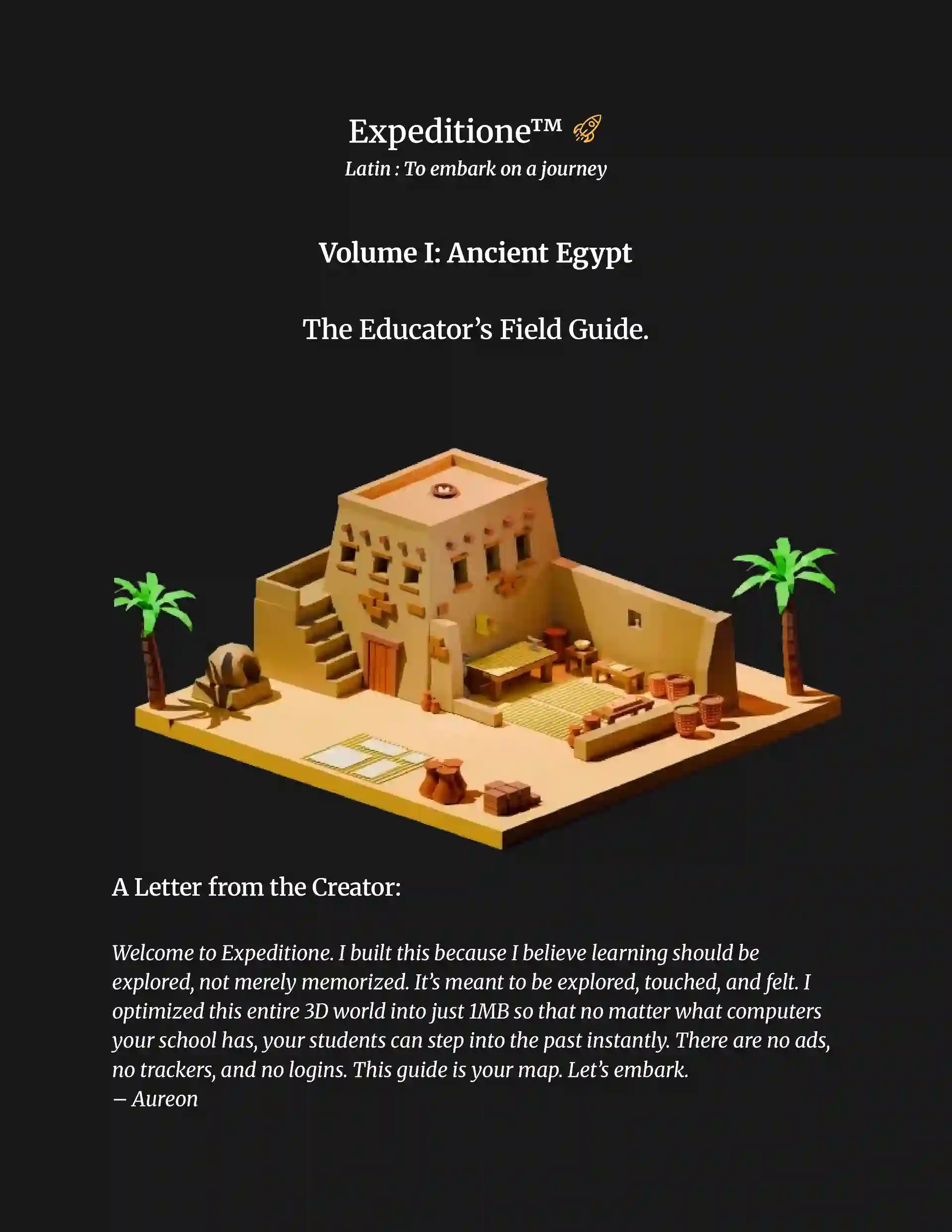
This is a stylized and artistic representation of history.
Created as a solo project
by Aureon.
Ancient Egypt Awaits
Click anywhere to continue
"Excellent choice. As if there was another."
This project is built with love, late nights, and a belief that learning should feel like an adventure.
Have a say in the future of our journeys. Cast your vote anonymously and help decide which corner of history, science or nature should be built next.
Vote now
Bring Ancient Egypt to life in your teaching. This museum-grade dossier includes guided discussions, interactive group activities, hands-on maker challenges, and printable worksheets tailored for student engagement.
This guide took months to research and design. I'm giving it away because I believe educators deserve better tools. If it made your teaching a little more interesting, the only thing I'd love is a way to tell you when the next one's ready.
I'm one person — I literally don't have time to spam you.
— Aureon
Iridescent River Shell
Plump Nile Fish
Harvested Wheat
Freshly Baked Bread
Sacred Blue Lotus
Vessel of Castor Oil
Village Children
Boy
Girl
Did you see Uncle Nebi yesterday? The hippo chased him all the way out of the tall reeds!
He was screaming and dropped all his fish in the mud! It was hilarious.
Hippopotamuses are fiercely territorial. And your uncle is fiercely unathletic. A dangerous combination.
Cleo
My sister is finally with child! She watered the grain bags yesterday and the barley sprouted instantly.
The priest says it will definitely be a strong boy.
How did Ptahemhat afford that new cedar boat? He's just a temple guard...
I heard he spent a lot of time 'patrolling' the western tombs last night in the dark.
I am sick of Nebi's donkey eating my flax. I paid the lector priest for a wax doll.
If that donkey comes near my field again, I'm tossing the doll in the fire.
Did you hear? The tomb builders just dropped their tools and sat in the dirt!
They are refusing to build the Pharaoh's tomb until they get their beer!
Have you seen Menna today? Both his eyebrows are shaved completely bare!
His favorite mouser must have passed on to the Field of Reeds.
My cousin works in the palace kitchens... he says they test the Pharaoh's food three times now.
They say one of the lesser wives has been speaking with the dark magicians...
Keep your voice down! The Medjay (elite police) have eyes everywhere.
I wouldn't want to be caught whispering about the royal harem.
My tooth is killing me, I can't even chew my bread!
You should go to the physician. I heard he has a special paste.
No way! Last time my brother went, the physician made him chew on a mashed-up dead mouse!
Eww! I would rather pull the tooth out myself.
Why did your mother shave your head again?
To keep the lice away. It's too hot to have hair anyway.
But now your head is completely bald and shiny like a river stone!
At least I don't have bugs crawling in my wig like you do.
Did you see Ahmose yesterday? He sliced his leg wide open with a copper sickle.
I did. The temple priest came and rubbed a chunk of fuzzy, green moldy bread into the wound!
Moldy bread? That sounds like absolute madness.
You would think so, but I saw him this morning and the redness is completely gone.
I heard the physician gave the Governor's wife a new remedy for her stomach.
What was it this time? Fermented acacia?
Worse. Crocodile dung mixed with sour milk.
May Thoth protect us from the physicians.
Did you see the Overseer's wife return from the Governor's feast last night?
I did! Her expensive wig was completely ruined.
The perfumed wax cone on her head must have melted too fast in the heat.
Exactly. She was drenched in scented oil from head to toe.
It smelled wonderful, like myrrh and lily, but she looked ridiculous.
The nobles strap those solid beeswax cones to their heads at every party.
I don't understand it. It ruins the linen dresses.
It is a sign of wealth and fertility, they say.
I prefer to stay poor and keep my clothes clean.
Did you speak to the tax scribe today?
I did. He was chewing so many honey-cinnamon mints, his breath smelled like an embalming tent.
At least he cares about his hygiene. Having bad breath is a disgrace.
True. I boil frankincense and pine seeds for my own breath pellets.
I heard the merchant had to burn his brand-new, expensive human-hair wig.
Really? Did it catch fire by the hearth?
No, he bought it from a shady trader downriver and it was completely infested with lice!
A hard lesson. I always shave my body completely bald.
It is the only way to stay clean in this heat.
And it saves money on expensive wigs.
The morning air is so cool, let's play before it gets hot!
I'm going to catch a frog down by the reeds.
Did you see the river? The water is perfectly still today.
My mother says Lord Sobek watches from the deep waters, we must be careful.
I hope we get fresh emmer bread for breakfast today.
Let's pretend to be scribes and write in the mud!
My father is already working the fields, he started before the sun.
Look! The silt left behind is so shiny in the morning light.
The air is cool now, but the midday sun will be brutal.
Yes, we must finish turning the soil before the heat sets in.
The river is generous. This rich, black silt will give us strong wheat.
I made an offering to Osiris at dawn for a bountiful harvest.
Have you checked the irrigation channel? We need to clear the blockage.
I'll do it right after a bowl of barley beer and some onions.
Be wary near the banks, Lord Sobek is active this morning.
Indeed, the Great One must be respected, but we have work to do.
The morning brew is thick today, just what we need for energy.
Did you hear? The scribe comes tomorrow to measure our plots for taxes.
Again? I hope they are fair this time, the Pharaoh's portion is always heavy.
Let's just be thankful for the good soil. Hapi has blessed us.
I need to get more castor oil for my lamps later.
The merchant by the river has some, but he drives a hard bargain.
My wife is already weaving the flax we harvested last week.
The linen will be fine this season, the stalks were very tall.
Let's hurry, the overseer will be making his rounds soon.
The morning mist is lifting over the Nile, it's beautiful.
Beautiful, yes, but it means the heat is coming.
I brought extra coarse bread today, want to trade for some green onions?
Gladly. We need the strength for the mud-brick repairs later.
Have the priests announced the date for the next festival?
Not yet, they are still observing the stars and the river's flow.
I must remember to gather some blue lotus before the sun closes them.
They will make a fine offering at the temple tonight.
Did anyone hear a splash? I hope it's not a hippo.
Just a plump Nile fish jumping. The river is full of life this morning.
Did you hear about the thief in the market yesterday?
He stole a whole basket of dates from the merchant!
But the Medjay (the ancient police) released their police baboon!
I saw it! The beast chased the thief straight up a palm tree!
The thief was screaming for mercy, throwing dates everywhere.
Those baboons are terrifying. I stay far away from them.
My uncle tried to keep one as a pet once.
It didn't work out. It threw a clay pot at his head.
The baker was so stingy yesterday! My morning beer was like water.
At least today it is thick and rich. Just what we need.
Exactly. How am I supposed to turn the soil all day on a watery brew?
The barley harvest was good this year, he has no excuse.
I will complain to the Overseer if he thins it out again.
Don't bother. The Overseer drinks wine, he doesn't care about our beer.
True. Let us just be thankful we have enough grain.
And enough strength for the long day ahead.
I am so tired of eating onions and lentils every single day.
We are farmers, not nobles. Meat is a rare luxury.
I know, but I can still dream. A slice of roasted meat would be divine.
You will have to wait for the Sed Festival.
That is months away! My stomach rumbles just thinking about it.
Perhaps you could catch a fish from the river.
And risk angering Lord Sobek? No thank you.
Then stop complaining and eat your bread.
Fine. But I am adding extra garlic.
My eyes are burning today, the flies won't leave me alone.
Did you forget your kohl this morning?
No, but I bought cheap soot from the merchant instead of real galena.
A foolish mistake. Real kohl protects against the sun and the sickness.
I know, I know. And now I fear the Evil Eye is watching me.
You must go to the temple and buy a real pot of kohl.
It is too expensive! The good galena comes from far away.
Your eyesight is more valuable than copper, my friend.
I suppose you are right. I will go tonight.
And wear it thick! It pleases Horus.
Do you want to play a game of Senet?
No way. The priest says it is not just a game.
What do you mean? It is just moving pieces on a board.
It is the journey through the Duat! The underworld!
If your piece lands on the House of Water, your soul drowns.
My father says playing Senet is how we speak to the dead.
Okay, fine. Let's just play in the mud instead.
Agreed. The mud is much safer than the Duat.
Did you see that massive scarab rolling dung by the river?
It is a blessed sign! The great god Khepri is at work.
Just as the beetle rolls the dung, Khepri rolls the sun across the sky.
And soon, baby beetles will emerge from the dirt.
Magical rebirth from nothingness. It is truly divine.
I found a dead scarab yesterday and buried it carefully.
You did well. The gods watch how we treat their creatures.
May Khepri grant us a good harvest tomorrow.
My brother just got assigned to the Great Pyramid project.
Is he hauling the heavy limestone blocks?
Yes, but he is very proud. He is in the 'Drunkards of Menkaure' crew.
The Drunkards? That is a hilarious name for a work gang.
They even painted their gang name deep inside the foundation stones!
They are highly skilled men. The Pharaoh pays them well in bread and beer.
It is an honor to build the eternal resting place for a living god.
I would rather stay here and farm the fields.
Me too. My back hurts just thinking about those massive stones.
I heard the priests in Shedet are complaining again.
What is the matter? Is the temple flooded?
No, it is Padisobek, the sacred crocodile.
The living incarnation of Lord Sobek! What is wrong with him?
He is getting too fat from eating all the roasted duck and honey cakes.
And his solid gold necklace is getting too tight!
A fat crocodile is a happy crocodile. It means the river will provide.
True, but I pity the priest who has to adjust that gold necklace.
I would not get close to those jaws, even if he is holy.
Especially if he is hungry for more than just roasted duck!
Farmers
Farmer 1
Farmer 2
Villagers
Village Man 1
Village Woman 1
Village Man 2
Villagers
Village Woman 2
Village Man 3
Village Man 4
Village Woman 3
Village Man 5
Shaduf Operator
Pull, lift, pour. Pull, lift, pour. Endless.
This counterweight saves my back, thanks be to Thoth.
The canals must remain full for the crops to thrive.
{PLAYER}, hold on! A Khamsin storm is approaching the temple courtyard. We can barely see!
This is the wrath of Sekhmet! Her sanctuary is sealed by the sands.
Wait, the Sacred Blue Lotus we bartered for in the village... it is a symbol of Nefertem, her son, and a symbol of peace. If we offer it at her altar, it might pacify her rage!
It worked! The air is completely clear... and look, the worshippers have returned to 'kiss the earth', the traditional pose of reverence! Welcome to the Temple Courtyard, {PLAYER}, a sanctuary where mortals commune with the divine.
I told you the lotus would pacify her. Though I must say, the midday heat in this courtyard is almost as brutal as the sandstorm.
Well, it's designed to let the sun god Ra's rays flood the space. It wasn't built with modern air-conditioning in mind, Cleo.
Ugh, details. At least the sand has stopped stinging my royal whiskers. {PLAYER}, don't just stand there basking. Let's find out what these mortals are doing.
I've isolated a few points of interest on the HUD, {PLAYER}. Click the golden markers to scan them.
Welcome back, {PLAYER}. The courtyard is still sweltering.
Interested in experiencing the Khamsin storm again? Here you go.
Look closely at the floor, {PLAYER}. Worshippers pressed flat against the stone in this intense heat. Why would they endure such agony?
Because they believe that statue is a living vessel, Aureon. If they stop feeding it, the connection breaks and the desert swallows the world.
Notice the vessels next to the statue, {PLAYER}. Tall clay jars and dark mud pots. They aren't empty, are they?
Far from it. They are filled with beer, bread, and oil. In the Delta, the villagers sweat to harvest the grain. In the temple, the gods demand it.
But the statue is stone. It can't consume physical food, Cleo. What really happens to all these offerings after the temple doors are locked?
Look up at the column capitals, {PLAYER}. Notice how they flare like closing lotus buds and papyrus stalks.
Precisely. We brought the river to the stone, transforming the sanctuary into a permanent model of the primeval marsh.
Look at the scale of this lioness statue. Who is she?
Sekhmet. The goddess of war, but also of healing. We build monuments to her to pacify the burning wind and plagues she commands.
Wait, so she is both the plague and the cure? A goddess of destruction and medicine?
Exactly. To survive the desert, you must respect its danger. If you can command the force of destruction, you hold the power of peace.
I suppose that makes sense, {PLAYER}. You don't run from the desert wind, you build stone walls to withstand it.
Wait, {PLAYER}! The sky is darkening again... the sand is starting to rise!
The Khamsin wind returns. Fifty days of fury cannot be stopped so easily.
But look closely at the columns. Even with the wind howling, they aren't budging.
Because stone does not blow away, Aureon. The temple remains. It is an anchor.
An anchor... so that's Clue 2. The temples were built of stone to withstand the collapse of the environment. Let's get out of this wind and head to the Quarry. I want to see how they actually carved these anchors.
Aureon
Cleo
Summon the Storm
Stop the Storm
⚠️ INCOMING KHAMSIN STORM
PROCEED TO QUARRY
A black granite statue of the lioness Sekhmet, the Goddess of War and Lady of Life.
The Great Hypostyle Hall in Karnak Temple features 134 massive sandstone columns.
Many columns are topped with open papyrus or lotus capitals, mimicking the marshes of creation.
Fossilized bread and dates found in ancient tombs, intended to nourish the deceased in the afterlife.
A tall ceramic vessel, commonly used to store grain, beer, or wine in ancient Egyptian storehouses.
A beautifully preserved wooden diorama of a brewery, showing servants hard at work.
A detailed stone relief carving depicting servants carrying baskets of food and provisions.
Welcome to the Tura Quarry, {PLAYER}. This is where the Great Pyramid truly began.
Cough... Dust. Excellent. You brought {PLAYER} to the sacred birthplace of pyramids... and the final resting place of my patience.
Don't be dramatic, Cleo. Look at the sheer scale of this trench, {PLAYER}. This is where they carved out the massive white limestone casing stones.
We're standing right at the extraction point. Now comes the hard part: moving a 2.5-ton (5,500 lbs) block from the quarry bed all the way down to that barge.
Finally, some manual labor I don't have to perform. {PLAYER}, click on that mining icon. Let's see if your aim is as sharp as your exploration.
Mud Pot
Water
Combine Items
Pour water on the sand
Water in a pot
Discovered
Transport VesselHEAVY CARGO BARGE
HULL: ACACIA WOOD
CAPACITY: 45 TONS (99,000 LBS)
CREW: 40 PERSONS
Administrative OutpostWADI AL-JARF FACILITY
OFFICIAL: INSPECTOR MERER
FUNCTION: LIMESTONE LOGISTICS
ERA: REIGN OF KHUFU (~2580 BCE)
Tura Quarry TrenchRAW LIMESTONE BEDROCK
MATERIAL: FINE WHITE LIMESTONE
YIELD: PRIMARY CASING STONES
LOC: TURA (EAST BANK)
Precision ToolCOPPER CHISEL
MATERIAL: ARSENICAL COPPER
WEIGHT: 450G [1.0 LB]
LOC: TURA QUARRY
Smelting StationTHERMAL SMELTERY
COAL: ACACIA CHARCOAL
TEMP: 1085°C [1985°F]
STATE: OPERATIONAL
Archaeological DataSCANNING FRAGMENT...
ESTIMATING ERA: OLD KINGDOM
Impressive work, {PLAYER}! That massive block is finally free. But now we have a 2.5-ton (5,500 lbs) problem: how do we get it all the way to that barge?
A wheel? {PLAYER}, you're a few centuries too early for that invention. Even when it arrives, it'll be for racing chariots, not for moving a block like this.
Now we need to find something to put this onto. {PLAYER}, can you find a tool that can help load this block to move it?
(Psst... check right beside that mud house!)
Great! You've found some Nile water. But wait... how are you planning to carry it back to the sledge?
Will you carry the river in your hands, mortal? I'd love to see you try.
Finally! The water to fill our vase. Now we can actually use it.
A sturdy clay vase! This will be perfect for holding liquids. Now, where can we get some water?
An empty pot in a desert. How poetic. Find something to fill it with, before I lose interest.
There we go. Now we have both the water and a way to transport it. Let's combine them.
Perfect! You've combined the Nile water with the clay vase. This creates a cooling effect through evaporation, keeping the water chilled even in the desert heat.
Finally, something cold. My paws were starting to feel like they were on a grill.
Monumental Feat
Congratulations.
You have moved
1 block.
Only
left to go.
You’ve contributed to
of the Great Pyramid.
Finalize Sequence
Look at this, {PLAYER}. This is a massive administrative outpost, modeled after Inspector Merer's facility at Wadi al-Jarf. It was the logistical heart of the entire transport operation.
It housed dozens of workers and stored the papyrus ledgers that tracked every stone block... and every daily ration of bread, onions, and beer.
Beer for breakfast? With a diet like that, it's an absolute miracle the pyramid lines are straight.
Cleoooooo.
Tee-hee.
Don't 'tee-hee' me. You're a cat. Cats don't 'tee-hee'.
Look at the sheer scale of this rock face, {PLAYER}. See those deep, narrow trenches cut directly into the solid bedrock?
They didn't have explosives. How do you snap a 2.5-ton block off a mountain using only copper and wood? They chipped the trench inch by inch, creating just enough space to jam massive wooden levers inside.
Then, they literally snapped the stone free. A monument to human engineering. And profound, tragic stubbornness.
Someone left their copper chisel behind! Copper was so incredibly valuable that tools were state property. Overseers weighed them after every shift so workers wouldn't steal the metal shavings.
Losing this was a financial disaster. It’d be like losing a brand new MacBook Air 💻 in the sand today.
Shiny. Mine. Add it to my royal treasury.
A copper chisel! You've found it. Now, {PLAYER}, let's get this back to its owner in Part 4.
Right. That mason's chisel has to be somewhere in this quarry. {PLAYER}, can you spot where a miner might have left his most precious tool lying on the quarry block?
There it is! A copper chisel just sitting on the quarry block. That's the modern equivalent of leaving your MacBook in a park and just... walking away. Let's get this back to its owner in Part 4.
Look at the men kneeling by the fire, {PLAYER}. That furnace had to grow hot enough to melt solid copper. Imagine kneeling in the desert sand, blowing into a reed next to a blinding white fire for ten hours a day.
They were 'Human Air Pumps'. A team of four to six men blowing in perfect rhythm. ......If they stopped for even a minute, the copper would solidify and ruin weeks of work.
They couldn't just measure it. They judged the temperature purely by eye. If the fire was orange, it was too cold. They had to blow until the flame was a blinding, dazzling white.
And if they accidentally inhaled with their mouth on the pipe... boom. A lung full of burning ash.
Mortals will truly endure anything to build something that outlasts them.
The craziest part is that this process was a highly guarded state secret. If you controlled the copper smelting process, you controlled the tools. If you have the tools, you can build a civilization... or an army.
Aureon
Cleo
This heavy transport barge will take the stones down the Nile to Giza. The river was the highway of the ancient world.
It is just a giant wooden box braving a very wet, very long river. Do not drop me in, Aureon. I have no desire to meet the crocodiles. I am strictly an indoor deity.
Good work finding the sledge, {PLAYER}. I see it has magically appeared on the quarry block, and two of my subjects already await their honorable labor.
Historically, moving a 2.5-ton (5,500 lbs) block down this ramp took 40 men and hours of agonizing labor. But my shift ended 10 minutes ago. And as a Guide of the Old Kingdom, I have certain... privileges.
[The sledge vanishes and instantly drops to the bottom of the ramp]
There. Much better.
Liar. You just invoked the magic of Thoth—our god of wisdom—to bend space because you didn't want to walk.
...
Let's start Phase 2.
Wait, it's stuck. Why aren't they moving?
Because it weighs 2.5 tons (2500kgs / 5500 lbs), mortal. Dragging that much stone on dry sand just makes it dig a deeper hole. You can't just pull it.
Ah, is it like dragging a car on a beach, {PLAYER}? Then we need to change the ground to make it slide?
Yes! {PLAYER}, look around the quarry. What can we use to reduce the friction? Try clicking on it.
Boom. It's just like walking on the beach. Pouring the exact right amount of water makes the sand firm instead of loose. It stops the sand from piling up and cuts the pulling effort by 50%. Absolute genius!!
See? My subjects were brilliant. Now that the sand is wet, they can walk it across the vast desert to the docks. Proceed.
Okay, now we have a massive stretch of flat terrain. Another perfect opportunity for my newly discovered divine efficiency.
[The sledge teleports exactly 500 meters forward]
Aureon. Thoth governs space, time, and wisdom. Not your profound laziness. You are making a mockery of my ancestors' endurance.
Who am I to argue with the gods, Cleo? Let's proceed, we have a boat to catch.
...
Alright, final stretch. We just hit a tight corner. To align with the barge, we need to carefully coordinate the workers to pivot the sledge exactly 90 degrees without snapping the ropes...
...
......
...Nah. Thoth, if you'd be so kind? [The block violently snaps 90 degrees]
...I have lived for three thousand years. I have watched empires rise and turn to dust. And I have never met a human with such a profound lack of shame.
The block made the turn and we saved 40 minutes of pulling. That's what I call an optimized workflow.
The block has arrived safely! Now, let's look into the family of one such worker who spent their lives pulling these stones.
Indeed. Let's head over to their quarters and see what daily life actually looked like between shifts.
Wait... what is happening in the courtyard?
Someone is arguing, {PLAYER}! And it sounds... surprisingly domestic.
Look at this mud-brick house, {PLAYER}. This is where the pyramid builders lived with their families.
A humble dwelling indeed. Though it lacks the grandeur of my palaces.
True, but it's here that the foundations of the entire workforce were nurtured.
Still no sign of the chisel here. {PLAYER}, think... where did we last see Egyptian masons with a chisel mining away at a stone block?
Exactly! It wasn't in this courtyard. We should check the Quarry once more.
Worker's Wage
Nebamun, if you left a state-issued copper chisel at the tavern again, the foreman is going to throw you in the Nile.
I didn't! I swear by Amun I had it! I set it down for *two seconds* yesterday to eat my garlic and bread!
Aureon
Cleo
Nebamun
Wife
Listen to that argument, {PLAYER}. Nebamun is panicking about the mud-mixers, and his wife is threatening to trade him for a better husband.
My subjects were professionals, Aureon, not whipped slaves. They had contract rights, and losing state-issued copper was a serious crime.
But wait... if they were free citizens, why would a family spend their lives working on a tomb for a dead king?
Let's search the house for clues, {PLAYER}. Look closely at the clay oven, his headrest, and the senet board.
Economic Data: The Paycheck
No chisel in the oven, {PLAYER}, but we found the wage: ten loaves of bread and two jugs of beer. They literally worked for calories, not gold. The state fed the families directly from the delta harvests.
2500 BC Health & Safety
Checking the bed... no chisel under the stone headrest, but notice this jar of green malachite Kohl. In this blinding sun, painting their eyes thick was actual protection against glare and flies.
The Timecard (Senet Board)
Checking the senet board... no chisel, but look at this attendance log! Nebamun was absent on Day 12 because of a scorpion sting, and on Day 17 because his wife was angry. And the state marked both as paid leave!
Congratulations 🎉 You have successfully proven this worker was not a slave.
Nebamun-Attendance Log
◦Day 12: Absent. {PAID}
Reason: Stung by scorpion.
◦Day 14: Absent. {PAID}
Reason: Brewing beer for a festival.
◦Day 17: Absent. {PAID}
Reason: Wife is angry with him.
[PAID]
Back to Search
I swear by the gods, I did not leave the chisel in the oven! I was only checking if the bread was done!
Our headrests are stone, Nebamun. Do you think I would not feel a copper chisel under my neck? Use your head!
And people still call my builders slaves. Look at this. Paid sick leave and excused absences. My workers were highly valued by the crown.
Discovered
Domestic Bread OvenMUD-BRICK BAKERY
MATERIAL: NILE MUD & STRAW
FUEL: ACACIA WOOD DUNG
USE: DAILY BREAD PRODUCTION
Stone HeadrestSLEEPING SUPPORT
MATERIAL: CARVED LIMESTONE
FUNCTION: NECK ELEVATION
USE: CLIMATE CONTROL & AIRFLOW
Senet BoardANCIENT BOARD GAME
MATERIAL: WOOD & FAIENCE
PLAYERS: 2 PERSONS
SYMBOLISM: JOURNEY TO AFTERLIFE
{PLAYER}, if you find his chisel, do not give it to him. Give it to me. I'll trade it at the market for a better husband.
I think she is serious, Aureon.
It's not here. Think, {PLAYER}... did we see miners with a chisel mining away at a stone block somewhere? Perhaps back at the Quarry?
"You lose it every week! Do you know how much a copper chisel costs? We could buy a donkey with that! Two donkeys!"
"I know! That's why I'm panicking! If I show up empty-handed, they’ll demote me to mud-mixer. My back cannot take mud-mixing!"
"{PLAYER}, if you find his chisel, do not give it to him. Give it to me. I'll trade it at the market for a better husband."
It's not here. Think, {PLAYER}. Where did we see miners with a chisel mining away at a stone block?
Wait, {PLAYER}... you already found it! I remember you picking up that copper shard at the Quarry.
IS THAT IT? GIVE IT HERE! By the gods, you've saved my back from the mud-mixers!
Praise Ptah! You found it! You saved my spine, {PLAYER}!
Where was it?
Uh... secured safely in a secondary location. Thank you, wife, I must go build a Mountain of Eternity now!
He's definitely going to lose it again tomorrow. But notice how Nebamun called it the 'Mountain of Eternity.' To these families, the pyramid wasn't just a grave; it was a giant state employment project that kept the entire country fed and united.
He's finally off to the site. Now maybe I can finish this weaving without hearing about 'missing copper' every five minutes.
I hope the Overseer isn't in a foul mood today. Nebamun is a good mason, but he has the focus of a startled ibis.
If he loses that chisel one more time... well, at least {PLAYER} was kind enough to help. Some people actually have sense.
Wait... Cleo... detecting a spike in the local hardware telemetry.
Telemetry? It's a house of mud and grain. Expect dust, not spikes.
Ah. I found it. I forgot to comment out the rat swarm script in my code. One second...
AUREON! WHY ARE THERE SO MANY RATS? THEY ARE IGNORING MY DIVINE PRESENCE!
Since you can't code a simple cat, I'll have to do it manually. Move aside, mortal.
HYAH!
STAY. DOWN.
FROM THE HEAVENS!
That... was effective. And slightly terrifying.
Effective? It's biology. My ancestors were the thin line between a civilization and a famine. No cats, no grain. No grain, no Egypt.
Right. Rats were the silent killers of the Old Kingdom. Cats were the 'Security Guards' of the granaries. Total historical accuracy, minus the flying.
They forgot my offering bread again. Three thousand years, and still no respect.
I built walls that outlasted dynasties. Nebamun can't even keep track of a chisel.
My Ba flies free every night, and what do I see? The same family drama. Every. Century.
The Weighing of the Heart was less stressful than watching him cook.
I left them a perfectly good house. They put a senet board where my shrine was.
Forty-two sins I was judged on. 'Losing state-issued copper tools' wasn't one of them, but it should have been.
Back in my day, we finished the tomb ON TIME. No excuses, no 'scorpion stings'.
They say the dead rest in peace. Clearly, they never had descendants.
Modes Explored
We've reached the end of our expedition.
Conclude the Journey
Look at this image. The internet will show you giants. It will tell you aliens moved these stones.
That is an INSULT to the thousands of men who engineered this miracle with nothing but copper, wood, and physics.
You know better. You moved the stone.
You followed it from the quarry...
...to the river...
...to the plateau...
...to the pyramid.
You met the people who built it.
They weren't giants. They weren't aliens.
They were human.
If someone tells you otherwise...
Send them here.
Let them meet the real builders.
Behold the Giza Plateau, {PLAYER}. For nearly four thousand years, nothing built by human hands stood taller.
Roughly 2.3 million stone blocks, fitted together with astonishing precision.
Before they could build a pyramid, they first had to solve a much bigger problem. How do you move a mountain?
Certainly not by dragging stones across endless sand. They brought the Nile to Giza. Let's investigate.
END EXPEDITION
You are looking at the Giza Plateau from above. To build these mountains of stone, the builders engineered a massive system of harbor basins and supply canals.
Look at the water inlet. That was the Khufu Branch of the Nile, which has completely dried up over the thousands of years. It allowed transport ships carrying Aswan granite to sail directly to the foot of Giza.
Explore the plateau to see how they divided the sacred temples from the bustling workers' town.
Each of these structures played a vital role in maintaining the pharaoh's eternal resting place.
Feel free to check out the other modes.
We've scaled the virtual world to match reality. Imagine standing right at the base of the Great Pyramid, looking up. The summit is 146.6 metres [481 feet] in the sky.
See that tiny green box next to you? That is a 1.7-metre [5.5 feet] tall human. Pile up some 3-story apartment blocks next to it and let's see how they compare.
That first block is a 10-metre [33 feet] building, a typical 3-story apartment block. A human already feels small next to it, but the pyramid dwarfs them both.
Five buildings stacked. 50 metres [164 feet] high. And yet, we haven't even conquered a third of this stone giant.
Ten buildings, or 100 metres [328 feet]. That is the height of a 30-story skyscraper. Imagine dragging blocks weighing as much as an elephant up to this height by hand.
And 15 buildings. 150 metres [492 feet]. We have finally topped the pyramid. This stone beacon remained the tallest structure built by human hands for over 3,800 years.
An unbelievable monument to human willpower.
That gives you a sense of scale, doesn't it? Feel free to investigate the other modes.
The choice is yours, mortal. I will be here when you return.
You are looking at the Great Quarry. A gaping wound in the earth, nearly half a kilometre [1,500 feet] wide and plunging 10 stories deep into solid bedrock.
Most people stare up at the pyramid and wonder where the stones came from. They came from right under their feet. The builders didn't just build a mountain; they carved out an inverted one first.
Imagine the sound. Copper striking stone. Thousands of hammers. Clouds of limestone dust hanging in the air from sunrise to sunset.
Watch the flow of time. As the quarry sinks deeper into the earth, the pyramid rises into the sky. An exact, mathematical transfer of mass from the ground to the heavens.
For twenty years. One block every three minutes. Sunrise to sunset. Again. And again. And again.
Every block left the quarry already knowing where it belonged. Their crews had names. 'Friends of Khufu.' 'Drunkards of Menkaure.' Those aren't the names people usually leave behind, unless they're proud of what they're building.
Back to the pyramid core. The internal anatomy of a 6-million-ton machine.
Click on the glowing chambers to read the field notes. There is much to learn.
Welcome to the drawing board. How do you lift 2.3 million blocks of stone, some weighing 80 tons, to the height of a 40-story building? The short answer is that nobody knows for sure. But we have three main theories.
Modern engineers still argue over how it was done. The pyramid isn't finished teaching us yet. Select the ramp theories on your screen to see how they would work.
The Straight Ramp. A simple earth and sand ramp stretching directly from the quarry to the top. To keep the slope gentle enough for men to pull blocks, this ramp would need to be 1.6 kilometres [1 mile] long.
A ramp that long would require more material than the pyramid itself. You would have to build two pyramids just to build one, making it highly impractical for the builders.
The Zigzag Ramp. An external ramp that snakes up the sides of the pyramid. It solves the length problem, but every corner becomes a problem.
Indeed. Imagine trying to pivot a multi-ton block around a sharp, narrow corner with nothing but ropes and wooden rollers, thousands of feet in the air. One slip, and it is a very long, very painful slide to the bottom.
The Spiral Ramp, specifically the internal spiral. Proponent Jean-Pierre Houdin theorizes that builders used a straight ramp for the bottom 30 percent, and then built an internal tunnel spiralling upward.
Look closely at the transparent pyramid. The ramp is inside! Microgravimetry scans actually revealed a spiral density anomaly inside the Great Pyramid, suggesting this might be the closest we have come to the truth.
Even today, the Great Pyramid guards its secrets. The ramps are gone and the tools are lost, but the achievement remains.
Which is exactly how it should be. A little mystery keeps you mortals humble. Empires disappeared. The questions remained.
X-Ray engaged. Notice the internal architecture. The sheer precision required to build hollow chambers inside 6 million tons of solid rock defies logic.
Logic is a modern obsession. To us, it was an armored vault—designed to withstand earthquakes, tomb robbers, and time itself.
Click on any of the glowing chambers to see the field notes. Every chamber hides another engineering decision.
You've selected the beating heart of the Great Pyramid. This rectangular room is built entirely of red granite brought from Aswan, over 800 kilometres [500 miles] away.
Look at the ceiling. Nine massive granite beams, each weighing up to 80 tons. Each beam weighs roughly as much as a dozen family cars, or two African elephants.
Now imagine raising one over forty metres into the air using only ropes, wood and human muscle. But notice something even stranger about this room.
The sarcophagus inside. It is wider than the doorway.
Which means...
It never came through that doorway.
They placed the sarcophagus first... then built an entire mountain around it.
King's Chamber
The main burial chamber constructed entirely of massive red granite blocks, located near the heart of the pyramid.
The ceiling consists of nine massive granite beams, each weighing up to 80 tons. Hoisting these to a height of over 40 metres [130 feet] without modern pulleys or cranes is one of the greatest engineering feats in history.
The granite sarcophagus inside the chamber is wider than the ascending passages leading to it. This proves the pyramid was built around the sarcophagus, rather than the sarcophagus being moved in later.
Contains the empty, lidless granite sarcophagus. Nine massive granite slabs form the flat roof above it.
This is the Grand Gallery. A towering corridor that slopes upward into the darkness, connecting the lower passages to the King's Chamber.
You are standing inside a solid mountain of rock, yet this hallway is almost 9 metres [30 feet] high. The walls step slightly inward as they go up, like a massive canyon of stone.
Every stone presses against another, redirecting millions of kilograms of force exactly where the builders intended.
And look at the floor edges. Those rectangular slots likely held massive wooden beams—an ancient, giant counterweight system used to drag the King's 80-ton roof blocks up the slope.
Grand Gallery
A monumental, steeply sloped corridor connecting the Ascending Passageway to the King's Chamber.
At 47 metres [153 feet] long and 8.6 metres [28 feet] high, its corbelled vaulted ceiling is an architectural masterpiece, stepping inward layer by layer to distribute the colossal weight from above.
Rectangular slots cut into the lower side ramps of the gallery suggest it may have housed a massive counterweight system, acting as an internal elevator to haul the giant granite blocks up to the King's Chamber.
Connects the Ascending Passage to the King's Chamber and features a mysterious step at the top.
You're looking at a chaotic, unfinished cavern carved directly into the solid bedrock, 30 metres [100 feet] straight down beneath the base of the pyramid.
Getting down here requires crawling through a suffocating tunnel the size of a kitchen table for over 105 metres [344 feet]. Thousands of tons of stone pressing down above you, in absolute darkness.
The room looks completely abandoned, full of rough-hewn rock and dead-end shafts. Some engineers believe this was a deliberate decoy—an ancient 'fake safe' designed to trick tomb robbers into thinking the burial chamber was already looted.
Subterranean Chamber
A rough, unfinished cavern carved directly into the bedrock beneath the pyramid, 30 metres [100 feet] below ground level.
The chaotic state of this chamber, complete with dead-end tunnels and a massive pit, contrasts sharply with the flawless precision of the upper chambers.
While some believe it was the original planned burial chamber that was later abandoned, others theorize it was designed specifically as a decoy to fool ancient tomb robbers.
Investigate the mysterious pit in the center and the short, dead-end corridor leading nowhere.
This is the true entrance, located 17 metres [56 feet] above the ground. Look at those massive, angled blocks above the doorway forming a giant 'V' shape.
Those are chevron blocks. They redirect millions of tons of weight away from the doorway.
Without those, the sheer weight of the pyramid above would have instantly crushed the entrance flat.
Original Entrance
The true, historical entrance to the Great Pyramid, located on the north face, 17 metres [56 feet] above ground level.
The entrance is protected by massive limestone chevron blocks. These function like an arch, distributing the millions of tons of downward pressure safely around the hollow opening.
The use of chevron blocks here and above the King's Chamber demonstrates the ancient architects' advanced understanding of structural stress and weight distribution.
Observe the massive chevron blocks that redistribute weight away from the entrance tunnel.
This is the descending corridor. A cramped, claustrophobic tunnel barely 1 metre wide. It plunges straight down at a steep 26-degree angle.
Imagine sliding head-first down a narrow, dark chimney pipe that is as long as a 30-story skyscraper laid on its side, cutting straight through solid bedrock.
Look at the tunnel. Over its entire length, it wanders less than the width of a wooden pencil.
Descending Passageway
A long, narrow tunnel descending at a steep 26-degree angle from the entrance all the way down into the bedrock.
Over its incredible 105-metre [344-foot] length, the tunnel maintains near-perfect laser precision, deviating by only a few millimetres from a completely straight line.
This precision was likely achieved using water-filled trenches for leveling and astronomical alignments with the North Star, showcasing their mastery of surveying without modern optical instruments.
Follow the steep descent all the way down into the bedrock to reach the Subterranean Chamber.
This passage suddenly branches upward, leading into the heart of the pyramid. But look at the bottom of it. It's completely blocked by three massive granite plugs.
Their final line of defense. Once released, the granite plugs sealed the passage permanently.
The workers who released the blocks were trapped inside. They had to escape through a secret, narrow well-shaft that dropped all the way down to the subterranean pit.
Ascending Passageway
An upward-sloping corridor branching off from the descending passage, leading to the inner chambers.
The lower end of this passage is permanently blocked by three massive granite plugs, forming an impenetrable seal that protected the upper chambers for thousands of years.
Ancient tomb robbers under Caliph Al-Mamun in 820 AD had to tunnel through the softer limestone around these granite plugs just to bypass them and enter the pyramid.
View the massive granite plugs that were slid down to seal the passage forever.
This perfectly horizontal tunnel branches off from the Grand Gallery and leads to the middle chamber.
Notice how flat it is, cutting through the mountain. But right at the very end, there is a sudden, mysterious drop in the floor.
No one knows exactly why. It might have been a structural shock absorber for earthquakes, or a symbolic boundary separating the world of the living from the sacred space of the dead.
Horizontal Passage
A flat corridor connecting the base of the Grand Gallery to the Queen's Chamber.
While the rest of the pyramid features steep angles, this passage is perfectly horizontal, except for a distinct, intentional step-down in the floor just before the chamber entrance.
The sudden drop in floor level is heavily debated. Some theorize it is a structural buffer against seismic activity, while others believe it is purely symbolic architecture.
Walk the perfectly flat tunnel connecting the Grand Gallery to the Queen's Chamber.
Don't let the name fool you. No queen was ever buried here. It was likely a room for the Pharaoh's spiritual statue, his 'Ka'.
Look at the walls. There are two small, narrow shafts, no bigger than a shoe box, shooting upwards through the pyramid. But they don't reach the outside.
When modern robots crawled up those shafts, they found tiny limestone doors with copper handles. It’s like a cosmic antenna room—launch tubes pointing exactly at the stars of Orion and Sirius, designed to shoot the King's soul into the heavens.
Queen's Chamber
The middle chamber of the pyramid, featuring a pointed gabled roof and a large, intricately stepped niche in the east wall.
Despite the name given by early explorers, this was almost certainly not a queen's tomb, but a sacred 'Serdab' designed to hold a life-sized spiritual statue of the Pharaoh.
Two small shafts (20x20 cm) extend from this room but never pierce the pyramid's exterior. Modern robotics explorations found them blocked by tiny limestone doors with copper pins, suggesting purely spiritual 'star shafts' for the soul.
Examine the intricately stepped corbel niche in the east wall, likely built to hold a statue.